 The SSO Server, Self-Service Console, Deployment Service, Reset Password Service Unlock Account Service and Emergency Access Service all provide user interfaces via web portals that can be customised if required.
The SSO Server, Self-Service Console, Deployment Service, Reset Password Service Unlock Account Service and Emergency Access Service all provide user interfaces via web portals that can be customised if required.
In versions 6.x of the DualShield Authentication Server portals are customised using features built in to the management console and accessed by navigating to "Customisation | User Interface";

Before you can customise sections of the portal you will need to create a new configuration. This is done by selecting the tab "Configuration" then clicking on the "New" button;

Once the "Create" button has been pressed you will be presented with a page that will allow you to customise one of the available portals;

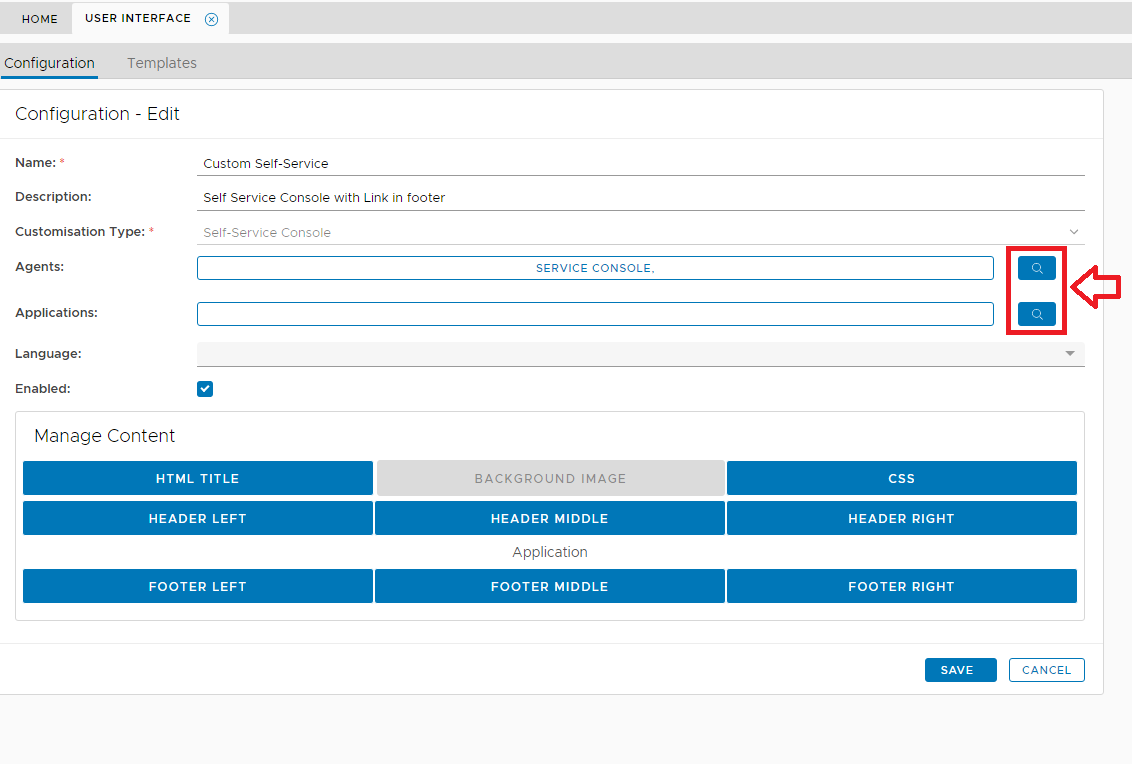
At the prompts "Name:" and "Description:" provide text that relates to the customisation you are about to perform, then at the prompt "Customisation Type:" select which portal is to be customised, then at the prompts "Agents:" and "Applications" click on the search icons (see arrow in the picture above), then select the agent that matches your selected customisation type;
You can now prepare the customisations using the section headed "Manage Content";

The blue buttons above indicate which sections of the web portal may be customised.
As an example we will customise the footer of our document so we click on the button "Footer Middle";

If we want to customise this section we need to uncheck the field "Keep this field empty", then in the text box we supply the content that will be displayed in this section of the web page..
The content can either be in plain text, or text in html form (for example we could add "<a href="http://das06.deepnet2fa.com:8076/drp" >password reset</a>" if we wanted to add a link to the password reset module)
Once the customised content has been entered click "Save", and repeat this process for any other sections you need to customise.
When you have completed entering your customisations the changes can be implemented by clicking on the checkbox prompted "Enabled:"

Now complete the configuration is saved by click on the "Save" button.
There is no need to restart any services prior to testing the web portals (however if the portal was open whilst the changes were being implemented then you will need to refresh the web page in order to view the changes). Provided the customisations were enabled and saved you can now see the effect of the customisations by simply opening the affected portal and examining the areas changed.